Frankenthaler
1928–2011American · Abstract Expressionism 1943–1965
At twenty-three she poured thinned paint onto raw unprimed canvas and invented a technique that an entire subsequent movement was built on. Mountains and Sea was painted in 1952; Louis and Noland saw it the following year and their work changed immediately.
Formation
Educated at Bennington under Paul Feeley, who taught her Cubist structure, and immersed in the New York scene through her relationship with the critic Clement Greenberg, who introduced her to Pollock's studio. Seeing the drip paintings and, crucially, the way paint had soaked into unprimed canvas in places, gave her the idea. She later married Robert Motherwell. She worked for six decades and resisted being read primarily through the men around her, with limited success during her lifetime.
Technique
Soak-stain. She thinned oil paint with turpentine to the consistency of watercolour and poured it onto raw, unprimed cotton duck laid flat on the floor, letting it spread and soak into the weave rather than sit on top of it. The paint becomes the canvas rather than a layer over it, which eliminates the distinction between figure and ground entirely — there is no surface to look at, only stained fabric. She guided the flow with sponges, squeegees and by tilting, and left large areas bare. Later she moved to acrylics, which soak without the oil's tendency to rot the fibres over time.
The palette
Translucent, luminous and washed. Because the pigment sinks into the fabric, colour behaves like watercolour on paper: it is transparent, edges bleed and halo, and the white of the raw canvas functions as light. She worked with broad areas of clear colour — blues, pinks, ochres, greens — that overlap into a third colour where they meet, and the accidental blooms at the edge of a pour are kept rather than corrected.
Legacy
Colour Field painting and the whole of what Greenberg called Post-Painterly Abstraction proceed from that single canvas. Her technical contribution is unusually precise and unusually attributable — a specific innovation on a specific date. The historical treatment of her as a bridge between Pollock and Louis rather than as a principal has been substantially revised, and the retrospectives of the last two decades have made the case on the work.
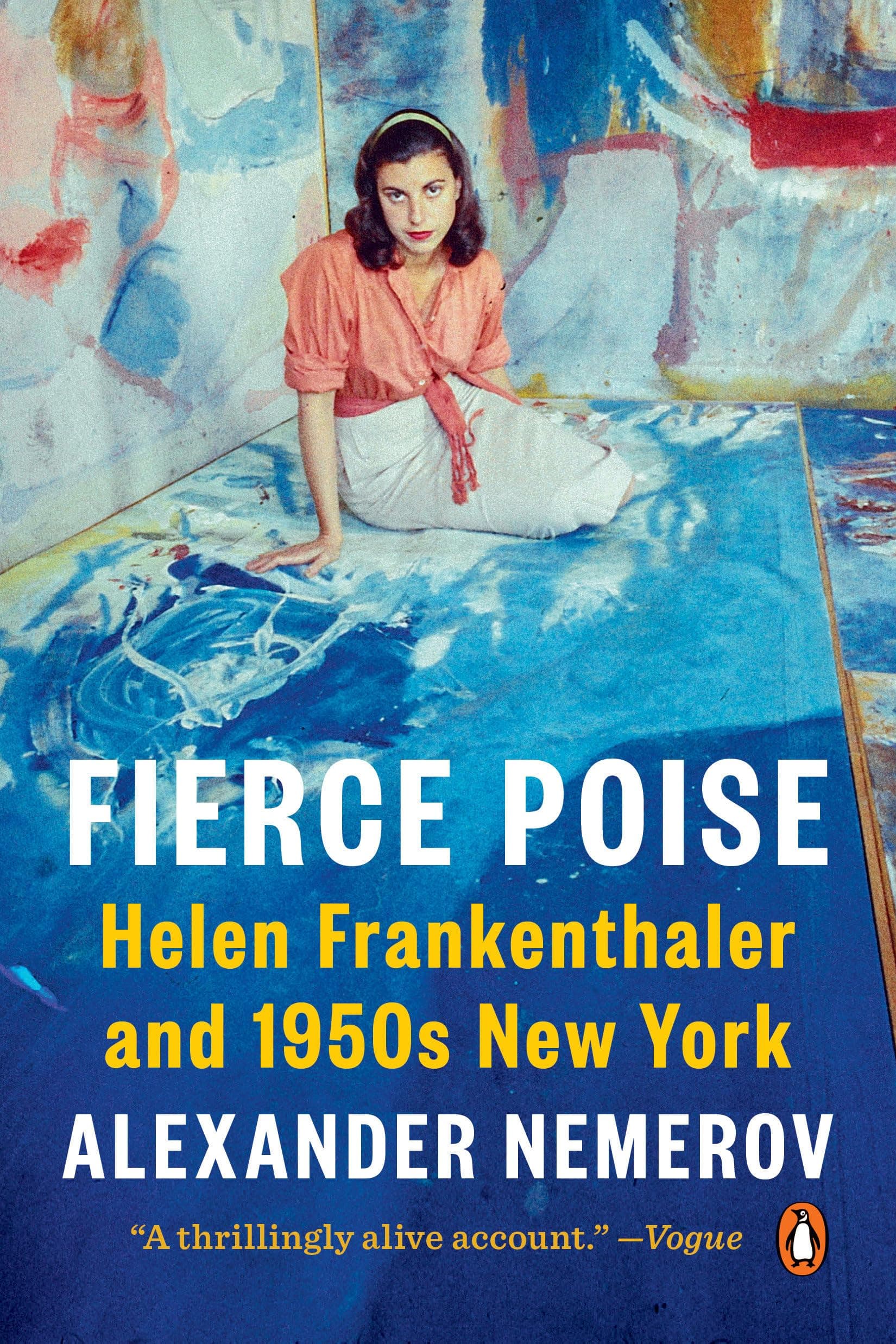 Further reading: Fierce Poise: Helen Frankenthaler and 1950s New York — Alexander Nemerov
Palette
The colours reconstructed for this artist, with the reasoning behind each.
Pigments used: Alizarin crimson · Viridian · Cadmium yellow · Sienna · Ultramarine · Cobalt violet
Also in this era
Working at the same time
Elsewhere in the atlas, in other movements and other media, these were the hands at work during the same years.