David Hockney
b. 1937British · Late 20th Century & Contemporary 1960–present
He has worked in oil, acrylic, photographic collage, fax, opera design, iPad and multi-camera video across sixty years, and the swimming pool paintings of the 1960s remain the images most people picture first.
Formation
From Bradford, trained at the Royal College of Art in London in the early 1960s alongside the generation associated with British Pop. He first visited Los Angeles in 1964 and the move to acrylic and to flat Californian light dates from there. He has divided his working life between California, Yorkshire and Normandy, and has published extensively on his own working methods and on the history of optical devices in painting.
Technique
Whatever the current question requires, and he changes tools often. The Californian paintings are acrylic on canvas, applied flat and evenly with rollers and brushes for a matte, even surface with crisp edges — acrylic dries fast and does not blend, which suits flat light and hard shadow. The photographic joiners of the 1980s assemble dozens or hundreds of prints into a single image with multiple viewpoints and timeframes, an explicit response to Cubism. More recently he has produced large bodies of work drawn directly on iPad, printed at scale.
The palette
Bright, flat and unshaded in the Californian work: pool blues, sharp green lawns, pink and ochre stucco, a high sun and hard-edged shadow. The English and Normandy landscapes go the other way, with saturated non-naturalistic colour — purple roads, orange tree trunks, green skies — applied at large scale across multiple joined canvases. His stated interest throughout is in how a picture is looked at over time rather than in a single instant, and the colour supports that by refusing atmospheric recession.
Legacy
His argument in Secret Knowledge, that many Old Masters used optical aids such as the camera obscura and concave mirrors, provoked a substantial and still-unresolved debate among art historians and conservators. His sustained interest in the technology of picture-making — from lenses to fax machines to tablets — is unusual in being both practical and historical at once.
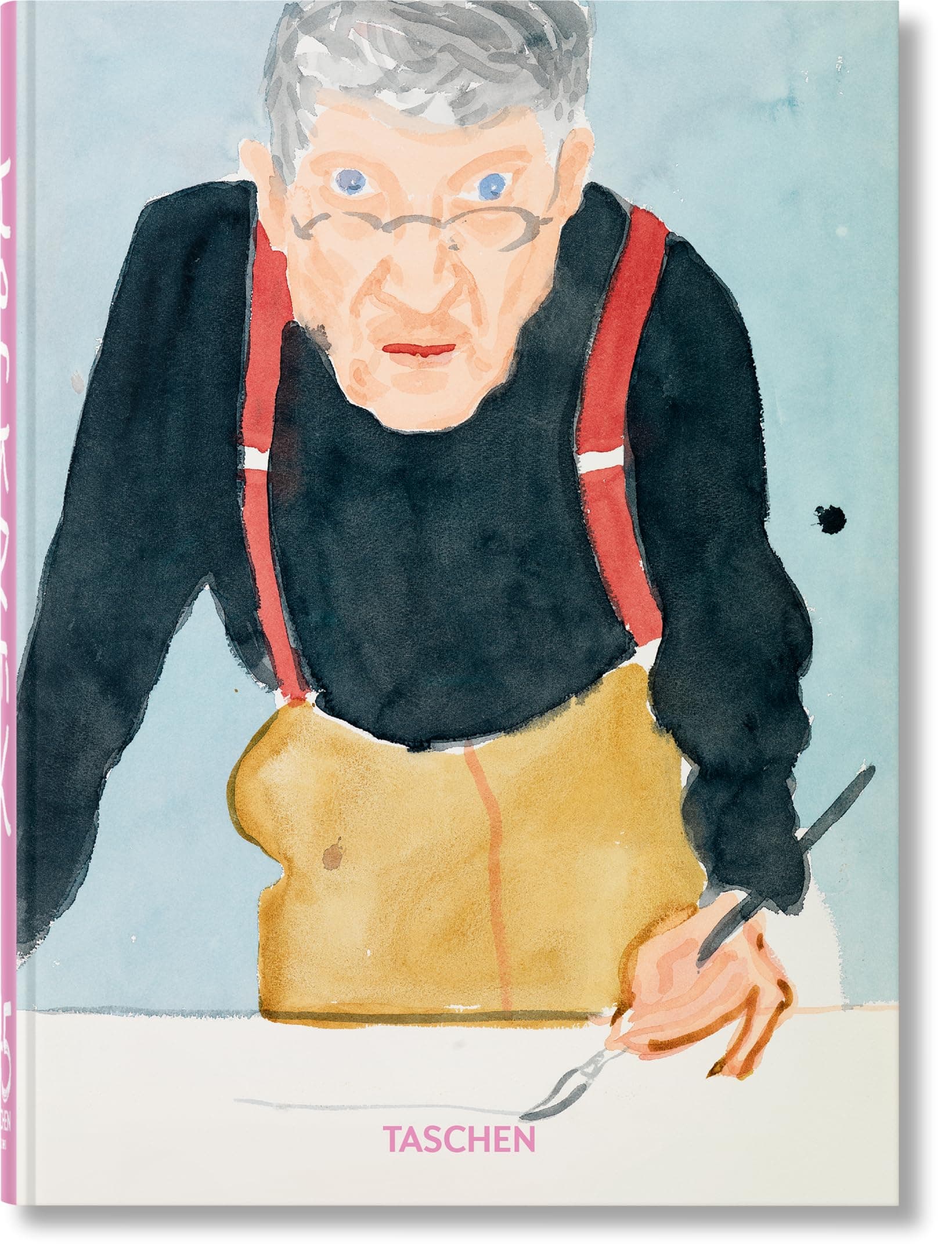 Further reading: David Hockney. A Chronology. 40th Anniversary Edition — Hans Werner Holzwarth (ed.)
Palette
The colours reconstructed for this artist, with the reasoning behind each.
Pigments used: Cobalt blue · Cerulean blue · Titanium white · Naples yellow · Cadmium yellow · Viridian · Ochre · Sienna · Umber
Also in this era
Working at the same time
Elsewhere in the atlas, in other movements and other media, these were the hands at work during the same years.