Jenny Saville
b. 1970British · Late 20th Century & Contemporary 1960–present
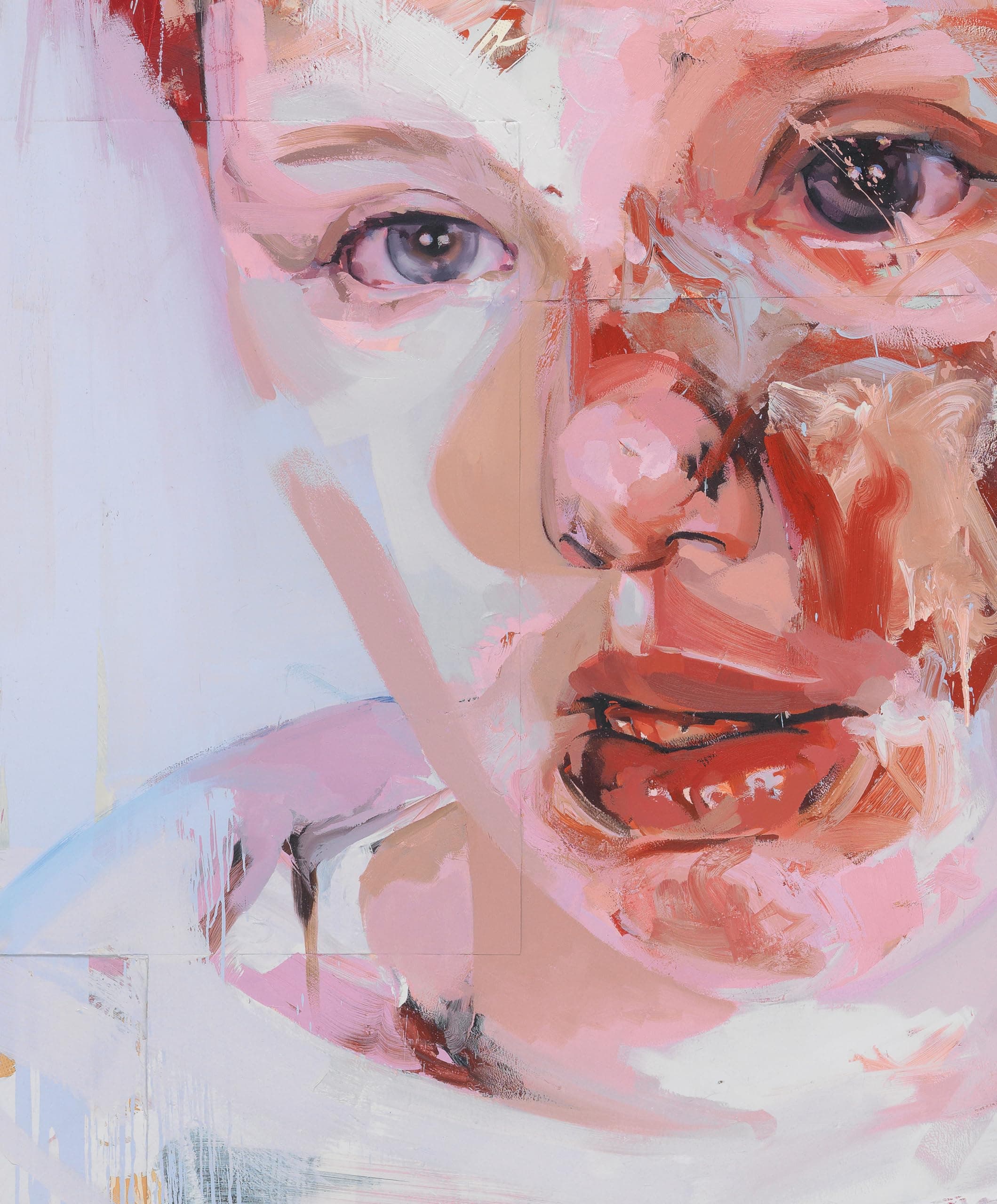
She paints the body at a scale that makes the viewer smaller than a thigh, using paint handled with the weight of the flesh it describes. The bodies are usually female, usually seen from below or above, and never composed for anyone's comfort.
Formation
Trained at the Glasgow School of Art, with an exchange year in Cincinnati that she has described as formative for its exposure to a different relationship to body size. Her degree show was bought in its entirety by Charles Saatchi, and she was included in the Sensation exhibition of 1997 among the artists grouped as the Young British Artists, though her commitment to painting from the body set her apart from most of that context. She has since worked between Britain and Italy, with a sustained engagement with the Renaissance.
Technique
Large-scale oil, worked thickly and physically. Saville paints on canvases several metres high, standing and moving, applying paint with big brushes in dragged, smeared and scraped passages that follow the mass of a body rather than its outline. She works from photographs, from medical imagery and from observation, and she has spent time observing plastic surgery, which informs the treatment of skin as a material that can be moved and stretched. Later work incorporates visible charcoal drawing left unresolved beneath and through the paint, with multiple superimposed contours held simultaneously.
The palette
Bruised, arterial and cold-lit. Pinks and whites through to violet, green and yellow ochre, with the flesh built from a wide range of unexpected hues rather than a skin tone — the greens and blues in a Saville body are structural, describing the way blood sits beneath a surface. The scale means the colour operates almost as landscape at close range and only resolves into a body at a distance.
Legacy
She is among the artists who made ambitious large-scale figurative painting viable again at the end of the twentieth century, and the treatment of the female body from a position other than the traditional one has been the substance of most writing about her. Her work is explicitly in dialogue with the history in this atlas — de Kooning, Freud, Rubens, Michelangelo — rather than in reaction against it.
 Further reading: Jenny Saville — Richard Calvocoressi, Mark Stevens
Palette
The colours reconstructed for this artist, with the reasoning behind each.
Pigments used: Cadmium red · Ochre · Lead white · Cobalt blue · Alizarin crimson · Naples yellow · Cadmium yellow · Sienna · Umber · Zinc white
Also in this era
Working at the same time
Elsewhere in the atlas, in other movements and other media, these were the hands at work during the same years.