Jean-Michel Basquiat
1960–1988American · Late 20th Century & Contemporary 1960–present
He went from spray-painting cryptic aphorisms on Lower Manhattan walls to the most expensive American painting ever sold, in about eight years, and died at twenty-seven.
Jean-Michel Basquiat's color palette
The colours reconstructed for this artist, with the reasoning behind each. Each swatch is an interpretation of the materials behind it, not a sample taken from a single work. How the palettes are made
Crown yellow
Bright yellow of the signature three-pointed crown.
Material: Cadmium yellow oil stick, spray paint
RGB(233, 192, 32)
Skull bone white
Off-white of exposed canvas and anatomical drawings.
Material: Titanium white acrylic, raw canvas
RGB(225, 216, 192)
Street red
Urgent red of spray paint and oil stick.
Material: Cadmium red oil stick, red spray paint
RGB(201, 32, 32)
Tar pit black
Dense black of outline and obsessive mark-making.
Material: Black oil stick, acrylic, spray paint
RGB(10, 10, 8)
Cobalt scrawl
Deep blue of gestural marks and text.
Material: Cobalt blue oil stick
RGB(42, 74, 154)
Anatomy ochre
Yellow-brown of anatomical drawings and self-portraits.
Material: Yellow ochre, raw sienna oil stick
RGB(202, 160, 80)
Pigments used: Cadmium yellow · Titanium white · Cadmium red · Cobalt blue · Ochre · Sienna
Formation
Born in Brooklyn to a Haitian father and a Puerto Rican mother, and largely self-taught as a painter. He was fluent in three languages and had absorbed anatomy from a copy of Gray's Anatomy given to him after a childhood car accident, which supplies the recurring skeletal and organ imagery. From 1976 he and Al Diaz wrote under the tag SAMO on downtown buildings. He moved to canvas around 1980, showed in the Times Square Show, and was internationally famous within three years. He collaborated with Warhol, and died of a heroin overdose in 1988.
Technique
Layered, fast and deliberately unresolved. Basquiat worked on canvas, wood, doors and found supports with oilstick, acrylic, spray paint, collaged photocopies and pencil, often several at once, and painted with the television on and the studio full of people. Words are central: he wrote, crossed out and rewrote text across the surface, and said he crossed words out so that people would want to read them more. The drawing is rapid and diagrammatic, faces are masks and crowns recur as a signature device.
The palette
Loud, high-contrast and unmixed. Cadmium reds and yellows, hard blues and greens straight from the tube, black oilstick over everything, with white used to scrub out and reveal in turn. Colour is applied in flat unblended areas that fight each other, and the surface stays busy — nothing recedes, everything is at the front. The effect owes as much to the street and to printed matter as to painting.
Legacy
He is the pivotal figure in the movement of graffiti-derived practice into the gallery system, and one of very few Black artists to achieve that level of recognition in the 1980s New York art world — a context his work addresses directly, repeatedly and critically. The market that followed his death has been extraordinary, and the 2017 sale of Untitled for $110.5 million reset expectations for post-war American art.
By Pigmentoria · Published · Palette: interpretive reconstruction
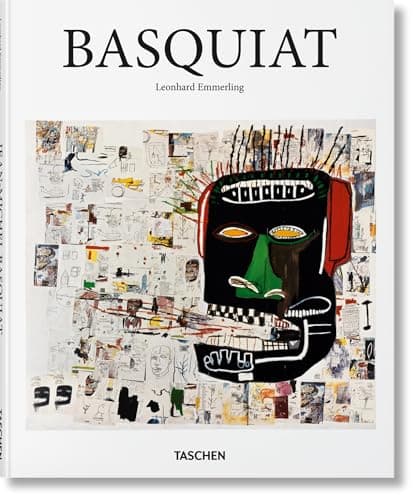 Further reading: Basquiat (Taschen Basic Art) — Leonhard Emmerling
As an Amazon Associate, Pigmentoria earns from qualifying purchases. This page may contain affiliate links.
Also in this era
Working at the same time
Elsewhere in the atlas, in other movements and other media, these were the hands at work during the same years.