Oswaldo Guayasamín
1919–1999Ecuadorian · Latin American Modernism 1920–1980
He painted hands. Enormous, distorted, expressive hands attached to figures with hollow faces, across a body of work explicitly about the violence of the twentieth century in Latin America and everywhere else.
Formation
Ecuadorian, of Kichwa descent on his father's side, and poor — he sold paintings on the street while studying at the School of Fine Arts in Quito. A formative journey through South America in 1945, and encounters with Orozco in Mexico and with Picasso's Guernica, shaped the direction. He built a career that was both international and politically committed, and spent decades on the Capilla del Hombre in Quito, a museum-monument to the peoples of the Americas, completed after his death.
Technique
Angular, flattened figures with heavy black contour, built from Cubist faceting and from pre-Columbian sculpture, painted in oil on canvas with a dry, matte, worked surface. Guayasamín simplifies a body to its structural essentials — hands, skull, ribs, mouth — and eliminates setting almost entirely, so the figure confronts the viewer without context. The paint is applied in flat planes with scraped and scratched transitions, and the drawing is deliberately harsh.
The palette
Bone, ash and blood. Black, white, blue-grey, ochre and a searing red or orange used sparingly at the point of maximum pain. The great series — La Edad de la Ira, the Age of Anger — is close to monochrome for long stretches, with colour arriving as a wound. He also used blue extensively in the later, tenderer works about his mother and about children, where the same simplified figure carries an entirely different charge.
Legacy
He is the most internationally recognised Ecuadorian artist and one of the defining figures of committed Latin American modernism, alongside the Mexican muralists. The Capilla del Hombre is one of the few purpose-built monuments in the region conceived by an artist as a complete statement. His portrait subjects included Fidel Castro, Neruda and Mitterrand, and the political alignment that came with that has always been part of the reception.
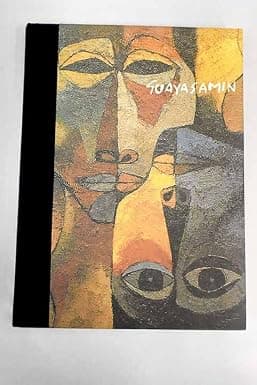 Further reading: Guayasamín — Generalitat Valenciana (catálogo de exposición)
Palette
The colours reconstructed for this artist, with the reasoning behind each.
Pigments used: Vermilion · Cadmium red · Ochre · Umber · Sienna · Cadmium yellow · Lamp black · Cobalt blue · Cerulean blue · Lead white
Also in this era
Working at the same time
Elsewhere in the atlas, in other movements and other media, these were the hands at work during the same years.