de Kooning
1904–1997Dutch-American · Abstract Expressionism 1943–1965
He refused to abandon the figure when abandoning it was the whole programme, and the Woman paintings of the early 1950s were attacked from every direction at once — too figurative for the abstractionists, too violent for everyone else.
Formation
Dutch, trained for eight years at the Rotterdam Academy in a rigorous commercial and fine-art curriculum, which gave him a technical grounding almost nobody else in New York had. He arrived in the United States as a stowaway in 1926, worked as a house painter and commercial artist, and did not have a solo exhibition until he was forty-four. He worked in the WPA mural programme, knew Gorky closely, and remained committed to drawing throughout.
Technique
Constant revision. De Kooning worked and reworked a canvas for months or years, scraping down at the end of a session, tracing what remained onto vellum, reapplying it and painting over — a method that keeps every previous state present underneath. He used long liner brushes for sign-painting to make the sweeping continuous strokes, and mixed his own medium with water, oil, solvent and sometimes mayonnaise or safflower oil to keep the paint workable and slow-drying for days. Woman I took roughly two years and was abandoned and retrieved from the rubbish.
The palette
High-keyed and fleshy. Pinks, oranges, yellows and acid greens against white and black, mixed wet on the canvas so colours drag through one another and never settle into flat areas. The pinks in particular carry a deliberate ambiguity between skin and paint. His black-and-white paintings of the late 1940s are the opposite extreme, using cheap black enamel and white house paint because he could not afford anything else, and they are among the strongest things he made.
Legacy
He kept a line open between abstraction and the figure that most of his generation had closed, and that line runs forward to Bacon, to Auerbach and to a great deal of later painting. His late work, made while suffering from dementia, has generated a long and unresolved argument about authorship, capacity and the point at which a body of work should be considered finished.
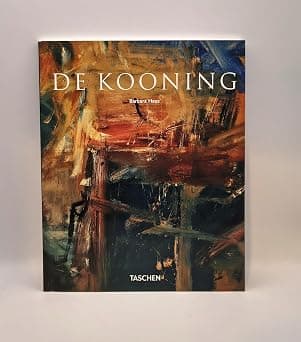 Further reading: Willem De Kooning (Basic Art Album) — Barbara Hess
Palette
The colours reconstructed for this artist, with the reasoning behind each.
Pigments used: Cadmium red · Ochre · Lead white · Cadmium yellow · Cobalt blue · Cerulean blue
Also in this era
Working at the same time
Elsewhere in the atlas, in other movements and other media, these were the hands at work during the same years.