Gerhard Richter
b. 1932German · Late 20th Century & Contemporary 1960–present
He has painted blurred photographs, monochrome greys, colour charts, and enormous abstractions made with a squeegee, and has consistently refused to settle into a style — the refusal is itself the position.
Formation
Born in Dresden and trained there in socialist realist mural painting, he left for West Germany in 1961, months before the Berlin Wall closed the route, and enrolled at the Düsseldorf Academy at twenty-nine to start again. That biography — an artist formed under one prescriptive system arriving in a market that prescribes differently — informs the scepticism about style that runs through everything. He later taught at Düsseldorf for two decades.
Technique
Several incompatible methods, kept running in parallel. The photo paintings are made by projecting or transferring a photographic image onto canvas, painting it carefully, and then dragging a soft dry brush across the wet surface to blur it — the blur is the last act and it converts a document into a painting. The abstractions are built with a squeegee: layers of colour are dragged across the canvas with a large blade, partly revealing and partly destroying what is beneath, over many sessions, with the result only partly under his control. He also works in glass, mirrors, overpainted photographs and digital prints.
The palette
Programmatically variable. The photo paintings are frequently grey, black and white, deliberately drained to keep them close to their photographic source; the grey monochromes push that to its limit as a refusal of expression. The colour charts use commercial paint-sample colours arranged by chance, removing composition from the equation entirely. The squeegee abstractions are the opposite: saturated, layered, with colours revealed in strata as the blade cuts through them, so the palette is archaeological rather than composed.
Legacy
He is among the most influential living painters, and the question his work poses — whether painting can still make truth claims after photography and after ideology — is the central question of post-war European painting. The Birkenau paintings and the 1988 cycle October 18, 1977, about the Baader-Meinhof deaths, are his most direct engagements with German history, and both work by obscuring their sources rather than clarifying them.
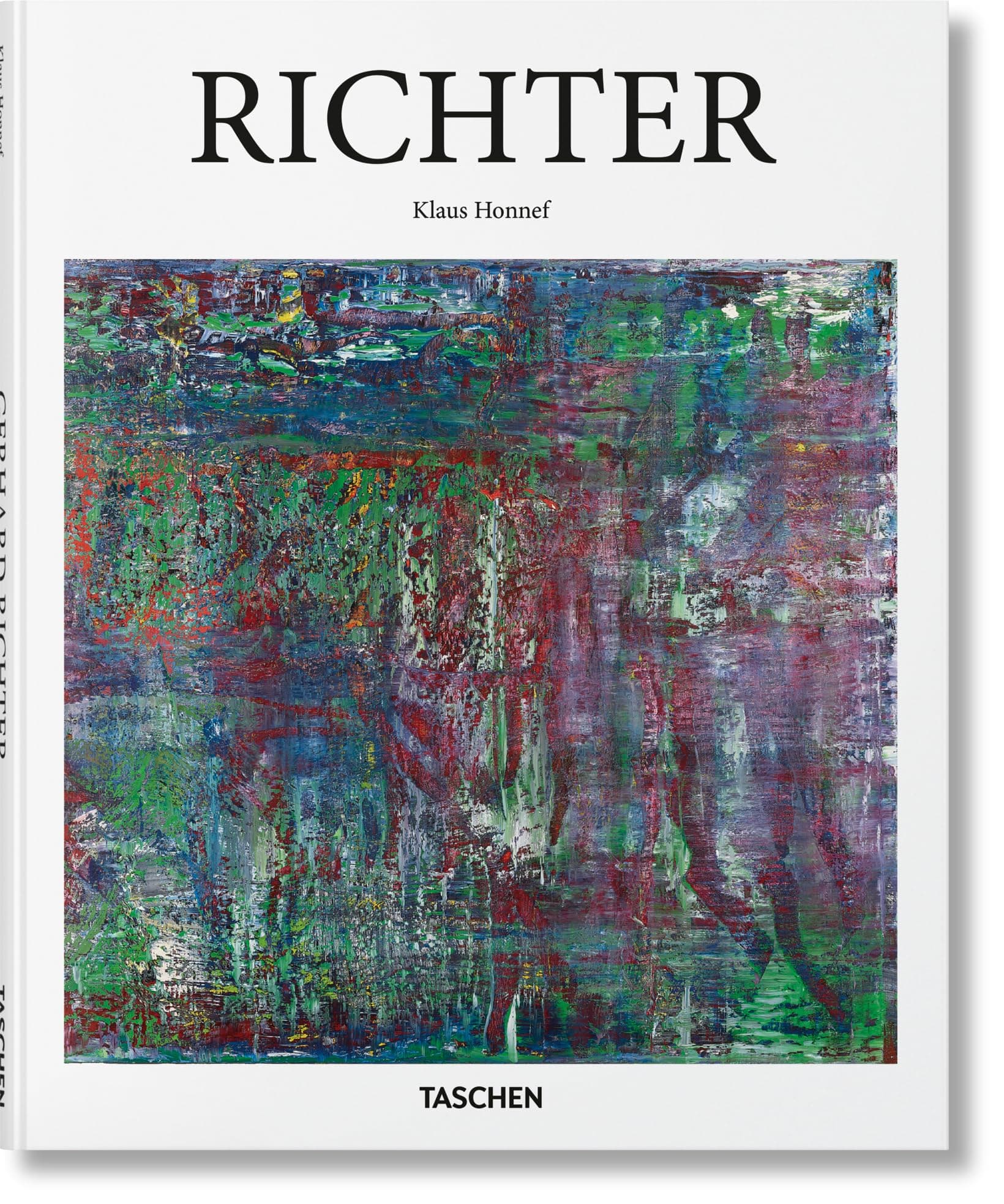 Further reading: Richter (Taschen Basic Art) — Klaus Honnef
Palette
The colours reconstructed for this artist, with the reasoning behind each.
Pigments used: Titanium white · Lamp black · Cadmium red · Cobalt blue · Naples yellow · Cadmium yellow · Viridian · Chrome green · Zinc white
Also in this era
Working at the same time
Elsewhere in the atlas, in other movements and other media, these were the hands at work during the same years.